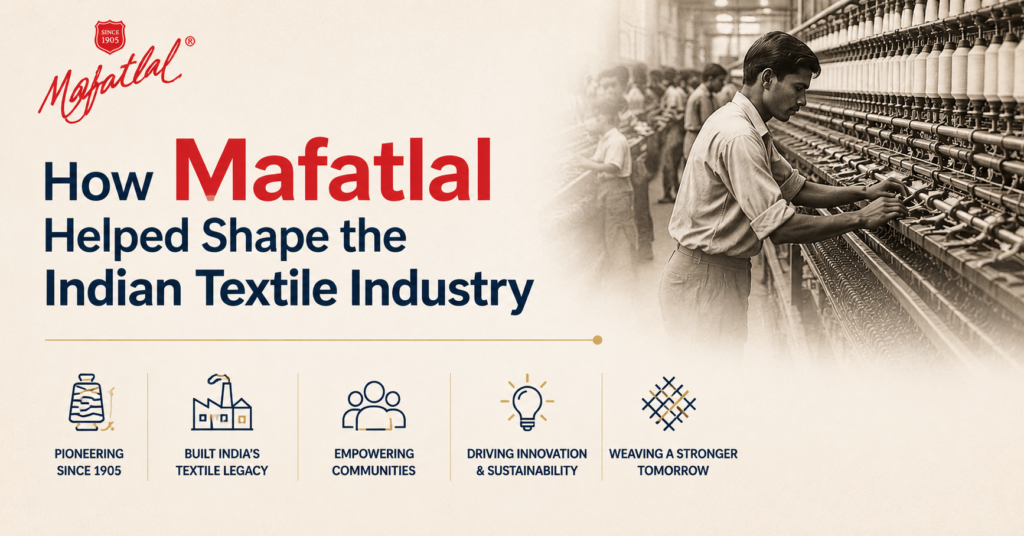
When reflecting on the historic evolution of Indian textiles, few names carry as much weight, reverence, and industrial gravity as Mafatlal Industries. Spanning over 120 years of excellence, the company has done far more than just weave cloth; it has woven itself into the socio-economic fabric of a nation. As one of the oldest textile companies India boasts, Mafatlal Industries has stood as a beacon of quality, serving as a pillar that supported the textile industry growth India experienced from pre-independence eras into the modern digital age.
The Visionary Founders and Leadership
The staggering fabric manufacturing legacy of Mafatlal Industries began in 1905 with its founder, Mr. Gagalbhai Mafatlal. Born into a modest weaving family, Gagalbhai started his journey by peddling textile products alongside his father. His sharp entrepreneurial drive eventually led him to establish his very first cotton mill in Ahmedabad. Between 1912 and 1931, his strategic expansion saw the acquisition of four more mills across Gujarat and Mumbai, positioning the firm among the premier textile pioneers in India.
Following the founder’s initial blueprints, his grandson, Mr. Arvind Mafatlal, took the reins in 1954. Under Arvind Mafatlal transformative leadership, the company achieved historic heights:
- The 1950s–1980s Era: He modernized cotton mills, catapulting the group to become the third-largest mill owner in the country. He pushed boundaries by expanding into chemicals, petrochemicals, and plastics through landmark joint ventures with global giants like Shell and Hoechst.
- National Recognition: His monumental contribution to the Indian textile industry and corporate philanthropy was later formally honored by Prime Minister Narendra Modi with a commemorative postal stamp.
In the decades that followed, Mr. Hrishikesh Mafatlal consolidated the group’s textile dominance, notably steering the brand into high-demand denim manufacturing through a partnership with Burlington Industries USA. Today, the fifth-generation, Mr. Priyavrata Mafatlal (CEO & MD), guides the group into a new era by blending traditional fabric mastery with healthcare textiles and educational technology.
Divisional Evolution Over the Years
Mafatlal’s ability to survive and dominate stems from its dynamic divisional evolution, adapting seamlessly to the shifting landscape of the Indian textile industry.
| Era | Key Milestones & Divisional Shifts |
| 1905 – 1954 | Founding & Rapid Mill Consolidation: Established by Mafatlal Gagalbhai; grew into a massive supply-driven network of cotton spinning and weaving mills. |
| 1955 – 1990 | Conglomerate Expansion: Diversified under Arvind Mafatlal into petrochemicals, rubber chemicals, and engineering while scaling up mainstream apparel fabric production. |
| 2000 – 2019 | Specialized Textile & Uniforms Division: Pivoted heavily into institutional, school, and corporate uniform fabrics, establishing a pan-India distribution network alongside home furnishings. |
| 2019 – Present | Technical Textiles & Technology: Launched a highly successful healthcare/non-woven division producing PPE kits, masks, and eco-friendly certified fabrics while branching into Ed-Tech. |
A Century of Impact on the Nation
The evolution of Indian textiles is marked by a transition from localized, manual operations to highly automated, sustainable mass production. As one of the definitive textile pioneers in India, Mafatlal spearheaded this evolution. From clothing the Indian armed forces during crucial periods to becoming the default choice for school uniforms across generations of families, its market presence remains unmatched.
By consistently introducing cutting-edge technologies and securing certifications like OEKO-TEX for sustainable processing. Mafatlal Industries has continually elevated the benchmarks for domestic manufacturing. The unmatched fabric manufacturing legacy they created proved that an indigenous enterprise could compete with global standards while staying deeply rooted in local communities.
Ultimately, the steady textile industry growth India achieved over the last century owes a great debt to the foundations laid down by the Mafatlal family. They transformed a humble family trade into an industrial powerhouse, securing their position as one of the most resilient and beloved oldest textile companies India has ever seen. Through every shift in global trade. Mafatlal Industries continues to wear its heritage proudly, remaining a foundational cornerstone of the Indian textile industry.